

Data-Driven Managers and Computerized Corporations. Corporate Information Systems in the Federal Republic of Germany, 1960s-1990s¹
by Michael Homberg, December 2025
In an age of technocracy and planning euphoria, computer specialists and especially programmers were emblematic characters. In Western Germany, for newspaper columnists like Karl Bednarik in 1965, they transformed everyday working worlds and heralded the end of the classical management. With their cold rationality, these experts – according to Bednarik – formed a new elite which was to take the place of managers as emotional, spontaneous and intuitive decision-makers. In fact, systems engineers, programmers, and IT consultants challenged established corporate hierarchies, managerial routines and orders, and thus established themselves as a new power group since the late 1950s.²
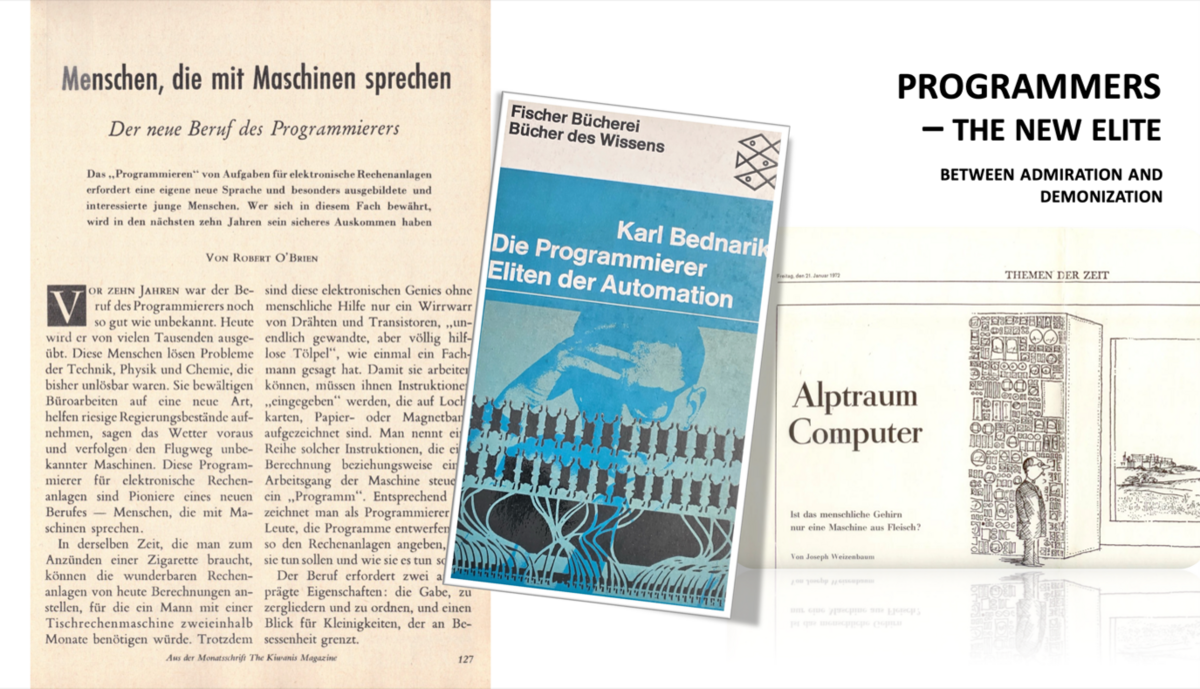
By this time, digital computers were implemented in business contexts as decision-making tools and shaped organizational processes, recruiting and education programs, as well as manager trainings. Yet, quickly, political controversies on data protection and employee rights issues surrounded the new automated personnel data systems. With a spotlight on the inequality, marginalization and biases woven into the technological systems, this essay aims to explore the changing role and image of computer experts and the rise of corporate information systems in Germany.
The Image of the “New” Manager in the Computer Age
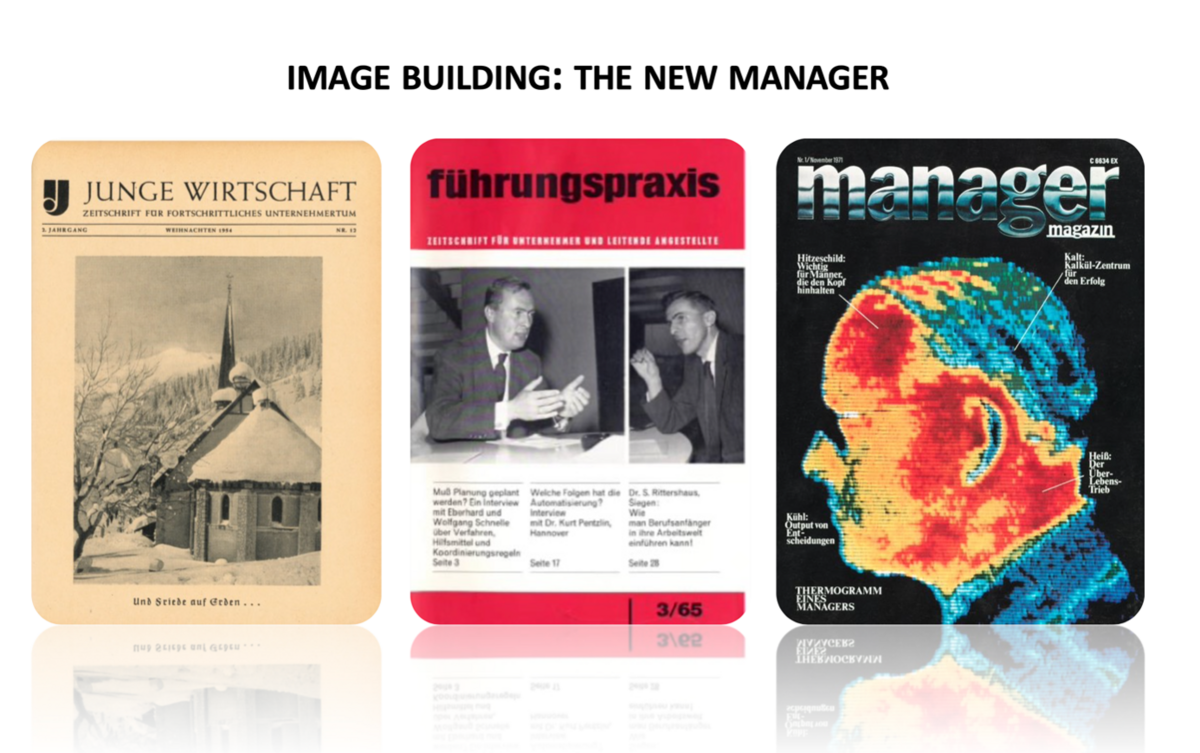
The early post-war period witnessed a vigorous discourse among German business leaders on how companies should be organized and managed, as new ideologies of leadership became a pressing issue. This process was initiated and guided by impulses from the United States. In 1940, James Burnham had coined the term “manager revolution” promoting a new social regime led by experts, specialists and technocrats.³ In a similar vein, in the 1950s and 60s Peter F. Drucker elevated knowledge workers to pivotal roles in the emerging “knowledge society.” This popularized managerial knowledge shaped socio-technical imaginaries by sociologists like Daniel Bell.4 Accordingly, scientific approaches to corporate management and the emergence of expertise as a key production factor were crucial factors in the rise of new managers. In the 1960s and 70s, magazines such as Junge Wirtschaft, Führungspraxis, and Manager Magazin played a decisive role in disseminating American management concepts throughout Germany, as they marketed a new managerial lifestyle, along with its attendant professional trajectories.5
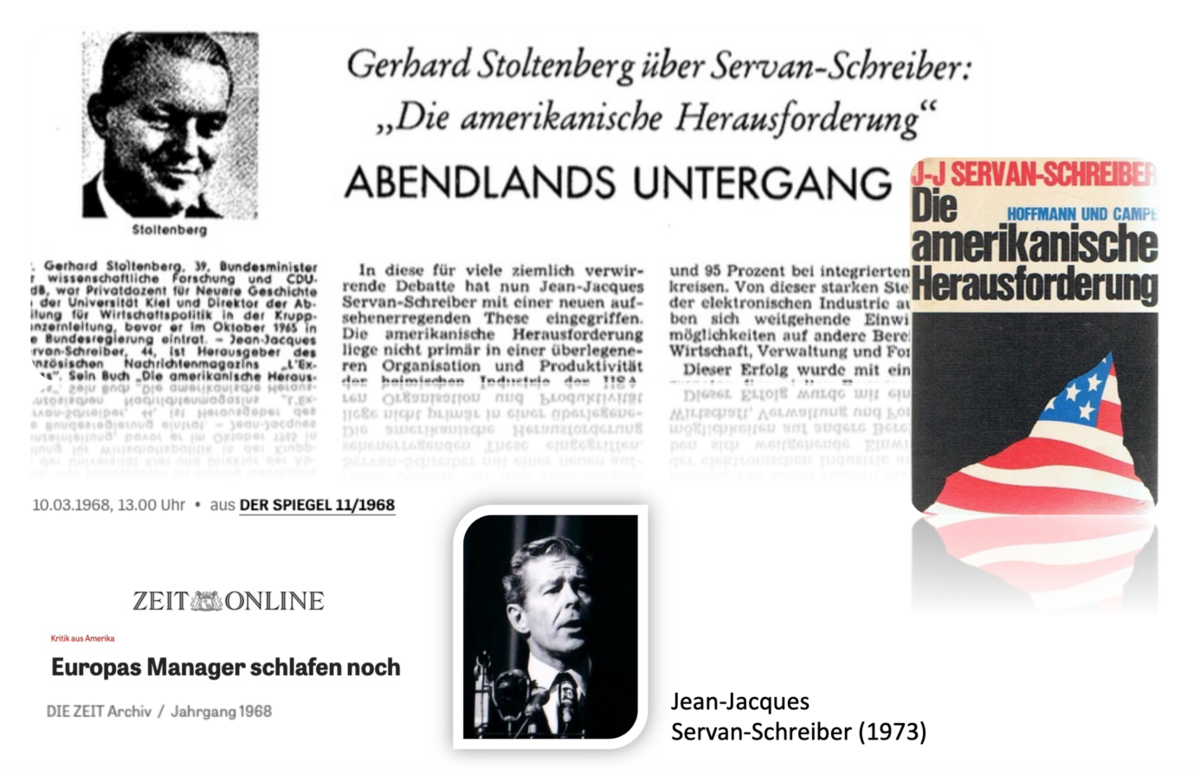
The call for new managers was met with enthusiasm, as traditional approaches appeared to be in crisis. In a 1970 memorandum by the European Commission on the Industrial Policy of the European Community, company owners and leading executives in numerous member states thus expressed a high degree of skepticism towards established corporate structures. This was due, as the memo stated, to a pre-modern management mindset which “prioritizes personality and experience over training and education”. The future of the European economy, hence, lay in “replacing intuition with reason and supplementing authority with communication and participation.”6 In line with the debate on the “technological gap” in 1968, which intensively discussed Europe's backwardness in high-tech fields, such as computer technology, aerospace or nuclear energy,7 contemporaries hence quickly diagnosed an “educational gap” and, above all, a “management gap” between Western Europe and the USA.
A key factor in modernizing managers and their methods was the use of computer technology. This shift was precipitated by a transition in managerial tools and styles by the 1970s, which was due to an ever-increasing mathematization of the economy, as well as the mounting prominence of management cybernetics. The rationalization of decision-making processes was prominently discussed in 1967 in the periodical Mensch und Arbeit. The advent of technical change effectively compelled “management to familiarize itself with the principles of automatic data processing”. Consequently, the newly appointed “specialists” posed a significant challenge to the “absolutist authoritarian way of thinking” that many entrepreneurs had long embraced.8 JoAnne Yates, Thomas Haigh and Nathan Ensmenger, have portrayed the politics of this organizational transformation and the struggle for occupational territory in the USA, as there was a massive battle for competence when the “computer boys” took over.9 In Germany, we see a similar pattern.
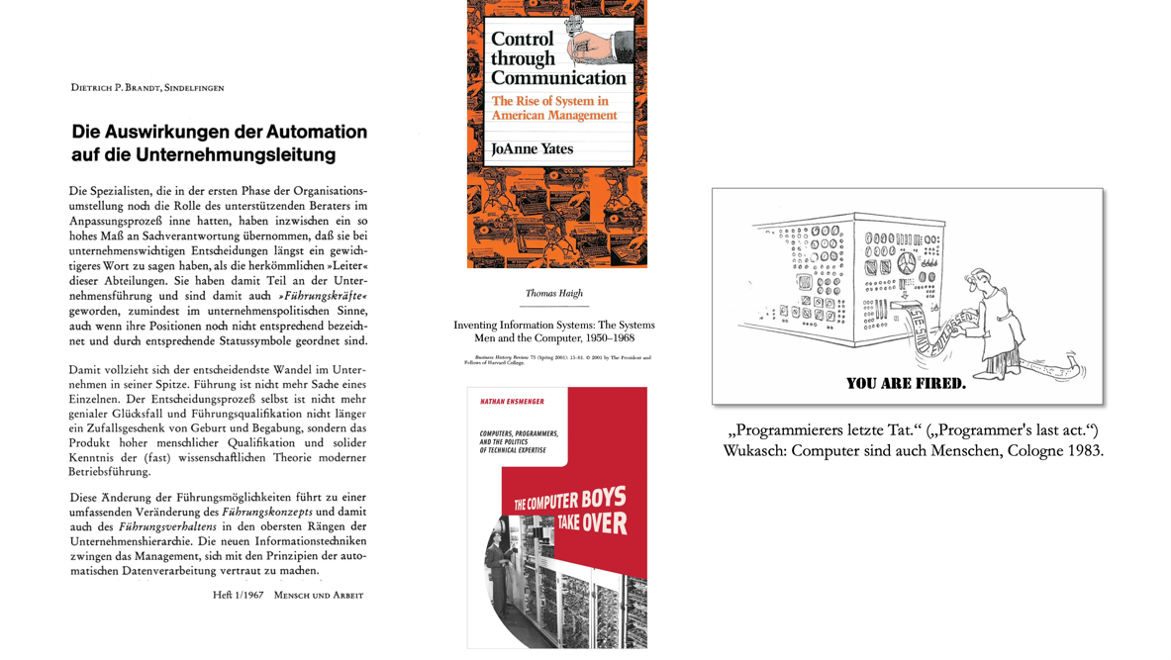
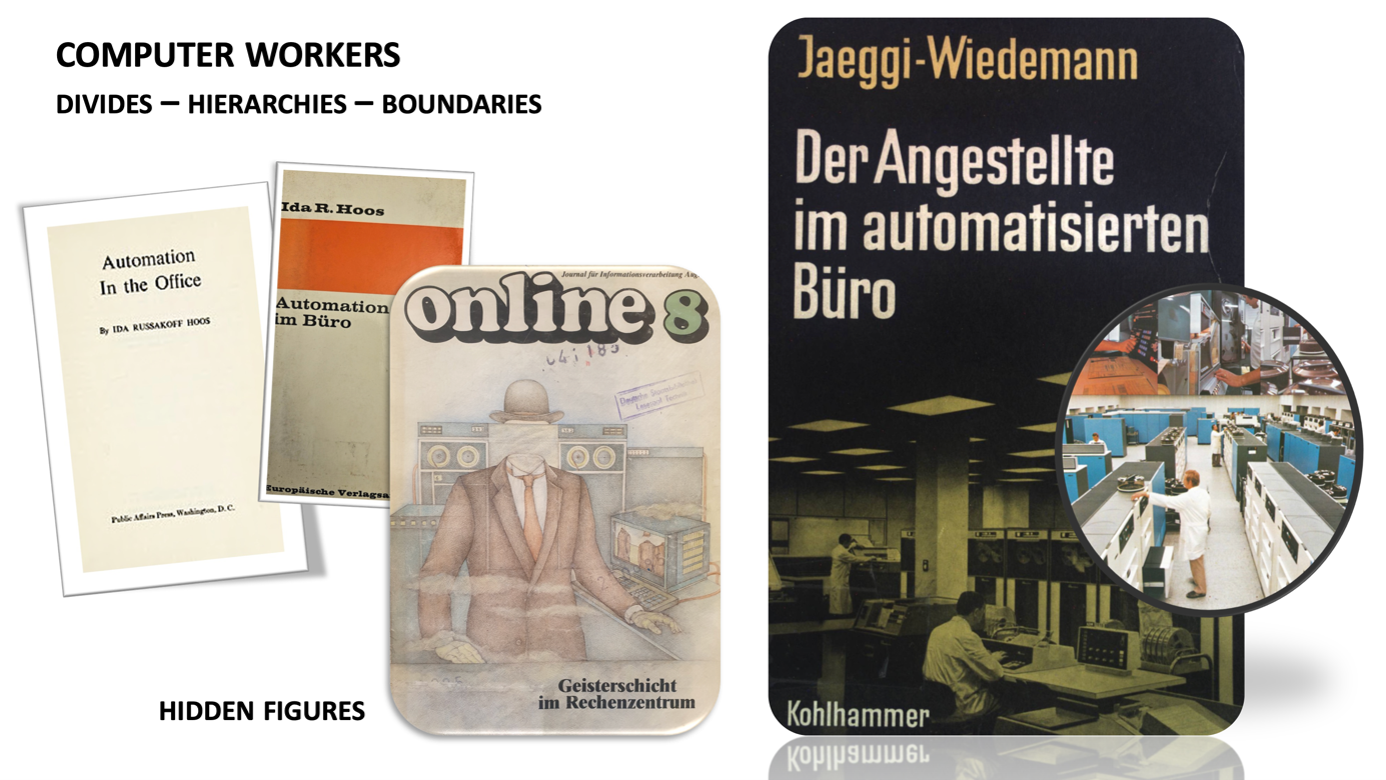
The computer industry, which was undergoing steady growth, produced its own hierarchies, divides and inequalities.10
Hence, conflicts arose between the elite of computer specialists, who claimed a high rank in the corporate prestige structure, on the one hand and the auxiliary and service staff, the punchers and machine operators, who worked physically and in shifts, on the other.11 As technology continued to evolve, there was an increasing need for enhanced managerial practices.12
The advent of computerization in management commenced with the training and recruitment of executives. In the late 1960s, the inaugural course of the Cologne University Seminar of Economics (“Universitätsseminar der Wirtschaft” in Köln) invited 48 managers to Bonn. The financiers of this newly founded business school, which set itself the elitist goal of training managers to “top executives” and thus closing the gap between business practice and academic theory, included around 100 leading German companies, such as Allianz, Bayer, Daimler-Benz, Deutsche Bank, Lufthansa, Siemens and Thyssen. Electronic data processing constituted an integral component of the course curriculum, encompassing both theoretical and practical aspects, as the program included a hands-on course on computer control units, connected to the “electronic brains” in the seminar centers. Thus, quantitative decision-making problems were to be facilitated by computers. The “leadership seminar modeled after Harvard's” gained immediate recognition in the press. The weekly magazine Der Spiegel reported on the “most rigorous training program ever conducted for top executives on German soil”.13
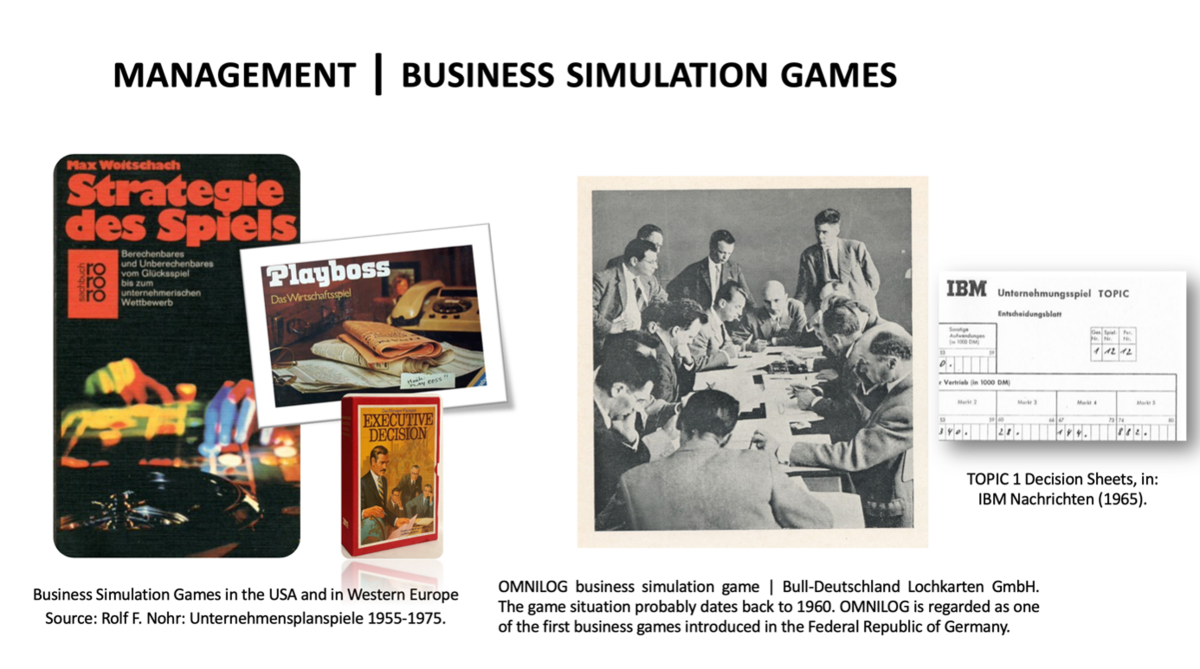
By then, an increasing number of companies were incorporating computers into business simulations. For IBM, Bull, Remington Rand, and Siemens, the computer was a tool for control and rationalization, based on cybernetics and operations research theories. They actively promoted the development of “entrepreneurial rationality,” emphasizing its role in decision-making processes. By the early 1960s, more than 30,000 US managers had played one of the more than 100 business simulations in existence at the time, and these corporate strategic planning simulations subsequently spread, particularly in Western Europe, such as the UK and the Federal Republic of Germany. An early example for this in Germany is a business game launched by IBM in 1960, which was based on the American version of the Management Decision Making Laboratory, but others, such as the OMNILOG game by Bull, or the TOPIC 1, utilized by Hoechst, Bayer, and many other companies followed, for training and educating their managers. Various business games shaped the computer as a tool for “learning management techniques”14 and the logic of managerial thinking shaped the zeitgeist, as business game mechanics and rationality order increasingly inspired popular board games such as “Playboss” in 1968 or the “Manager-Planspiel” in the early 1970s.
Meanwhile, computerized “management information systems” provoked publicity. These systems were imagined in the 1970s as “fully integrated” information and control systems, in which all data pertaining to personnel, as well as business and decision-making processes were consolidated. Accordingly, managers were expected to utilize such comprehensive systems to evaluate and enhance the efficacy with which they directed the company. According to James D. Gallagher, a practitioner and member of the American Management Association, the aim was to make a company's entire data volume available to management, both accessible and comprehensible, and ideally in real time. Furthermore, all systems were to incorporate monitoring and control functions. The idea to see corporate organizations as systems – which has been famously portrayed through the rise of systems men in the USA in the 1950s and 60s15 – was hence based on concepts of computer systems that, as critics said, exhibited panoptic potential.
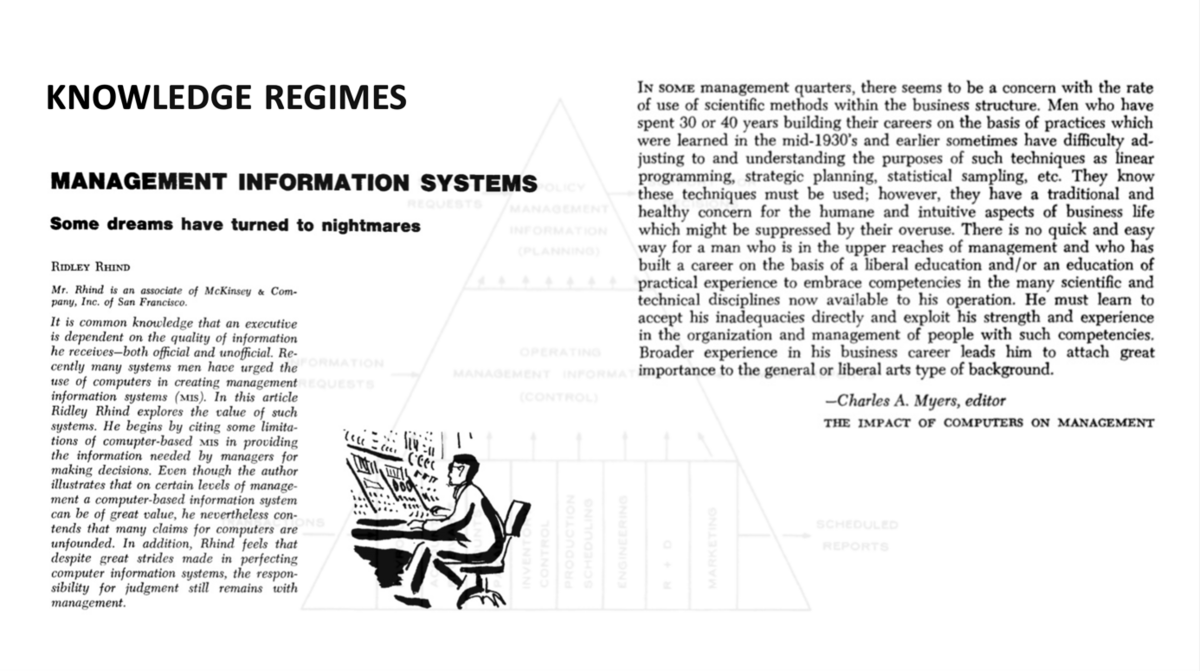
Yet, in practice, such “total” systems mostly remained imaginary, as the costly experiments yielded only partial solutions, including individual areas such as sales, finance, accounting, and human resources. However, they were viewed controversially as the systems paradigmatically reflected the dreams and anxieties of the digital age.
Panoptic Managers and Computerized Employees – Political Controversies on Enterprise Resource Planning Systems
The critique on computer usage in corporate settings was merged into a wide-ranging societal dialogue concerning the potential hazards of the computer revolution. After all, concerns about surveillance and control by computers were pervasive at the threshold of the 1980s. The literary specter of "Big Brother" loomed large over all aspects of society, significantly influencing the discourse on enterprise resource planning systems in the Orwell year.16
Civil society activists who – as an autonomous, non-commercial media center in Hamburg (mpz) – promoted utopias of critical counter-publics, directed to schools, labor unions and works meetings, and, hence, politized the debate. Thus, they explicitly linked new human resources information systems with the state's efforts to collect data. The census initiative, which led to widespread protest in West Germany in 1983, and the computerization of police authorities and secret services, which gained prominence at the end of the 1970s, were regarded as emblematic of the German “data rush”17 which was increasingly perceived as problematic.18
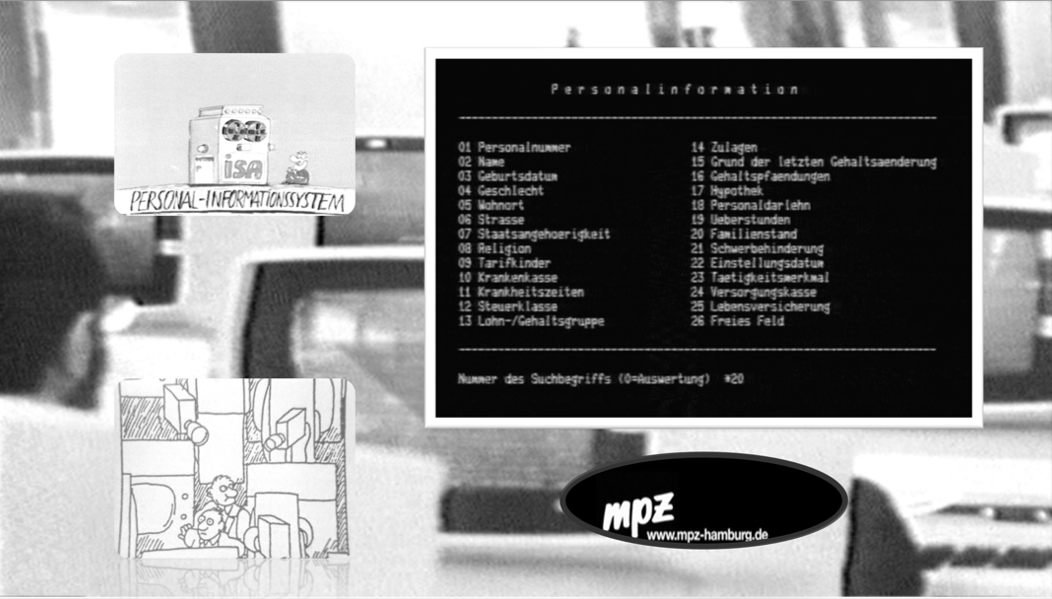
A 1980 comparative study on the use of integrated information systems in large German companies, including Volkswagen, Daimler-Benz and Salzgitter AG, asserted a “rationalization” and “centralization of decision-making powers at the top of the company”, which would strengthen the position of “senior executives”.19 An activistic compilation movie with the title “Control through Computer-Assisted Information Systems”, edited in the Orwell year for screening at corporate and work council meetings, addressed the deep-rooted fears articulated by industrial workers, with a special attention to Daimler-Benz. There, the Information System for Work Assignment and Workplace Planning (ISA) had been intended to assess the employees' suitability for tasks within the company, based on personnel records and HR registers.20
Scenarios which allowed companies to access private data, including performance reports, educational track records and personal achievements, figures on sick leave and overtime, as well as social security and pension details, caused a stir, as concerns regarding the surveillance and oppression of employees' actions rose. The Industrial Union of Metalworkers and opposition works councils hence collected 9,000 signatures among Daimler-Benz employees in Untertürkheim who openly objected to the processing of their personal data. A works agreement, concluded in 1980, eventually stipulated that data on work restrictions may only be processed anonymously and that no evaluations may be made by linking workplace and employee data. Nevertheless, the works council's co-determination rights remained limited. While similar protests happened at the Opel production sites in Rüsselsheim (with more than 25,000 signatures), the Volkswagen corporation managed to keep the situation relatively calm, thanks to greater participation by the works council and a newly designed data protection commission.21
According to Siemens central HR departments representatives in the mid-1980s, the idea of the “computerized employee” remained barely more than a popular imaginary.22 The trade unions, which explicitly stressed the connection to the census (and thus occasionally even allied with church representatives), nonetheless, continued to revive the debate on a new surveillance capitalism by underscoring the perceived lack of autonomy among employees within contemporary work environments, as over 2,000 systems were in charge already. In this context, they drew particular attention to remote work arrangements, which were said to embody the “brave new working worlds” with its struggles to control data and employees.23 In 1984/85, the heated debate even spilled into the parliament, where the governing coalition by Christian Democrats and Liberals praised the tools as making “personnel decisions fairer, faster, more reliable and cost-effective”, while oppositional social democrats and Green party politicians explicitly evoked the image of “Big Brother” corporations to criticize behavioral monitoring, performance pressure and a climate of (self-)discipline, and to promote a new informational self-determination.24
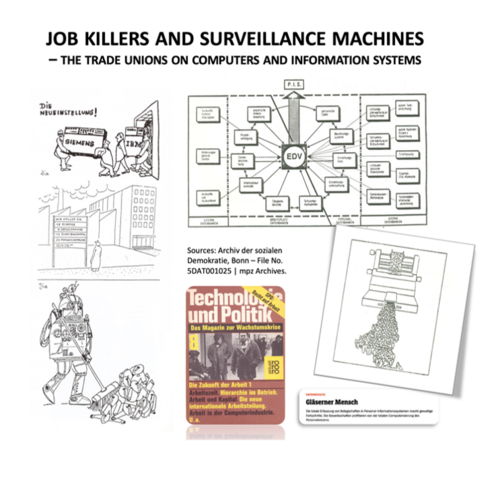
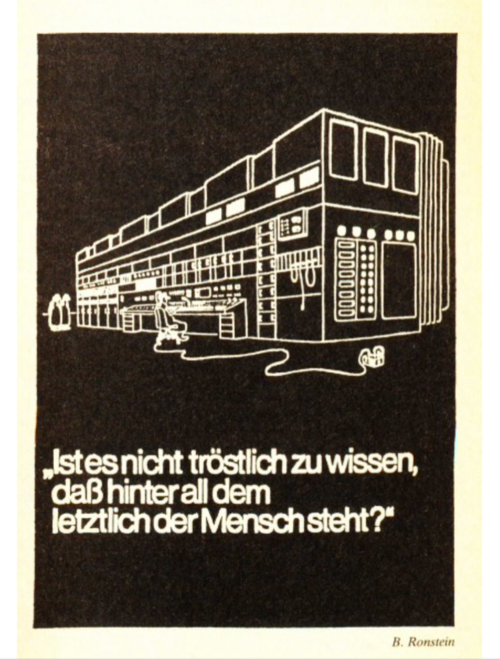
Fundamentally, the criticism was grounded in the everlasting concern that computers were rationalization machines. Topical research has described this narrative as a long-standing trope of the digital age. Yet, we can hardly draw a line between the databases and downsizing ambitions, even though increasing transparency and streamlining work processes in the HR area were among the primary goals of corporations.25 Rising concerns, impressively portrayed, for instance, in 1978 by Der Spiegel,26 however, remain explicable – especially in the light of growing unemployment, economic crises and accelerated technological changes, as with the advent of microelectronics. The discourse on data-driven managers and computerized corporations hence spoke to broader public controversies on computers and the right to one's own data. Since the workplace became politicized and larger discourses on workers' participation were interlaced with computer criticism, disputes over new digital systems, designed to organize human resources and managerial issues, escalated into a contentious debate in the late 1970s and early 80s, as shown.27 Nevertheless, by the time database-supported control systems were progressively implemented in the 1990s, the initial uproar had already subsided. This was partly because surveillance was less pervasive than originally anticipated, and regulations curbed more ambitious plans, but also because people gradually became accustomed to the new technology, which replaced the pronounced luddism with a new, striking optimism. The controversy, thus, marks a crucial lesson in the long-standing cultural expectations and societal negotiations over the pathways to a digital society.
1 This essay is based on my talk @ ICOHTEC 2025 on June 30, 2025 in Dunedin, New Zealand.
2 Karl Bednarik: Die Programmierer. Eliten der Automation, Wien/München 1965.
3 Bernhard Dietz: Der Aufstieg der Manager. Wertewandel in den Führungsetagen der westdeutschen Wirtschaft, 1949–1989, Berlin/Boston 2020, pp. 45-67 and pp. 105-111. On the manager disease, see Patrick Kury: Der überforderte Mensch: Eine Wissensgeschichte vom Stress zum Burnout, Frankfurt a.M./New York 2012, pp. 118-145.
4 Christiane Reinecke; Wissensgesellschaft und Informationsgesellschaft, Version: 1.0, iAn: Docupedia-Zeitgeschichte, 11.02.2010. DOI: https://dx.doi.org/10.14765/zzf.dok.2.568.v1.
5 Dietz: Manager, pp. 98-107; pp. 139-157. See also: Susanne Hilger: „Amerikanisierung“ deutscher Unternehmen. Wettbewerbsstrategien und Unternehmenspolitik bei Henkel, Siemens und Daimler-Benz (1945/49–1975), Wiesbaden 2004, p. 250.
6 Memorandum der Kommission der Europäischen Gemeinschaften betreffend die Industriepolitik der Gemeinschaft. Deutscher Bundestag, 9.4.1970. Drucksache VI/606, pp. 110-113.
7 Michael Homberg: Who is leading Innovation? German Computer Policies, the “American Challenge” and the Technological Race of the 1960s and 1970s, in: Media in Action 1,1 (2017), pp. 93-114, here: p. 95-97. DOI: https://doi.org/10.25969/MEDIAREP/16238.
8 Concurrently, by the 1970s, the advent of routinized programming work became imminent, which appeared to relegate computer specialists as “manual workers” to a subordinate rank. See Philip Kraft: Programmers and Managers. The Routinization of Computer Programming in the United States, New York 1977. For a critical view on this diagnosis, see David A. Hounshell: Are Programmers Oppressed by Monopoly Capital, or Shall the Geeks Inherit the Earth?, in: Ulf Hashagen et al. (eds.): History of Computing: Software Issues, Berlin 2002, pp. 167-176, here: p. 172.
9 JoAnne Yates: Control through Communication: The Rise of System in American Management, Baltimore/London 1993; Thomas Haigh: Inventing Information Systems: The Systems Men and the Computer, 1950-1968, in: The Business History Review 75,1 (2001), pp. 15-61; Nathan Ensmenger: Letting the “Computer Boys” Take Over, in: International Review of Social History 48,3 (2003), pp. 153-180.
10 See generally: Michael Homberg: Datenarbeit. Der Anbruch des digitalen Zeitalters und die Entwicklung von Computer-Dienstleistungen in der Bundesrepublik, in: Sabine Pfeiffer et al. (eds.): Digitalisierung der Arbeitswelten. Zur Erfassbarkeit einer systemischen Transformation, Wiesbaden 2024, pp. 37-65, here: p. 42. DOI: https://doi.org/10.1007/978-3-658-44458-7_2; Rüdiger Hachtmann: Rationalisierung, Automatisierung, Digitalisierung. Arbeit im Wandel, in: Frank Bösch (ed.): Geteilte Geschichte. Ost- und Westdeutschland 1970–2000, Göttingen 2015, pp. 195-237, here: pp. 219-222; Frank Bösch: Wege in die digitale Gesellschaft. Computernutzung in der Bundesrepublik 1955–1990, Göttingen 2018, p. 28.
11 Dietrich P. Brandt, Die Auswirkungen der Automation auf die Unternehmungsleitung, in: Mensch und Arbeit 19,1 (1967), pp. 19-24; Guido Fischer: Die wachsende Zahl der „Spezialisten“ verändert Personalorganisation und Führungsformen, in: Personal 22,1 (1970), pp. 2-5; Norbert Altmann/Guido Kammerer: Wandel der Berufsstruktur, München 1970. On corporate hierarchies, see exemplarily: Urs Jaeggi/Herbert Wiedemann: Der Angestellte im automatisierten Büro, Stuttgart 1963, pp. 132-135; pp. 182-195; p. 228f.
12 Niklas Luhmann already stated this in his work: Organisation und Entscheidung, Opladen 1978, pp. 20-25. For more on Luhmann's view, see: Ricky Wichum: Auf der Schwelle. Die Systemtheorie Niklas Luhmanns, die Kybernetik und der Computer um 1970, in: Alfred Nordmann et al. (eds.): Steuern und Regeln. Jahrbuch Technikphilosophie, Baden-Baden 2019, pp. 85-101, here: p. 95.
13 Nacktes Überleben, in: Der Spiegel, 1.9.1969. URL: https://www.spiegel.de/politik/nacktes-ueberleben-a-d67e6da2-0002-0001-0000-000045522365. Cf. also Dietz: Manager, pp. 182-202.
14 Rolf F. Nohr/Theo Röhle: „Schulen ohne zu schulmeistern“. Unternehmensplanspiele in den 1960er-Jahren, in: Zeithistorische Forschungen 13,1 (2016), pp. 38-60. DOI: https://doi.org/10.14765/zzf.dok-1415; Kerstin Hoffmann: Spielende Manager. Unternehmensplanspiele in bundesdeutschen Unternehmen in den 1960er und 70er Jahren, in: Zeitschrift für Unternehmensgeschichte 61,2 (2016), pp. 160-189; Rolf F. Nohr: Unternehmensplanspiele 1955-1975, Münster 2019, pp. 229-280.
15 Haigh: Systems Men. See also: Michel Domsch: PIS, Hamburg 1973, p. 1; Florian Wrede: Computergestützte Management-Informationssysteme. Geschichte – Zukunft – Konsequenzen, Wismar – Working Papers, 2007, p. 5f. For computer criticism, see also DGB (ed.): Neue Technologien. Gefahren, Chancen, Perspektiven, Düsseldorf 1985, pp. 32-60, here: p. 37f.
16 Nicolas Pethes: EDV im Orwellstaat. Der Diskurs über Lauschangriff, Datenschutz und Rasterfahndung um 1984, in: Irmela Schneider/Christina Bartz/Isabell Otto (eds.): Medienkultur der 70er Jahre, Wiesbaden 2004, pp. 57-75; Eva Oberloskamp: Auf dem Weg in den Überwachungsstaat? Elektronische Datenverarbeitung, Terrorismusbekämpfung und die Anfänge des bundesdeutschen Datenschutzes in den 1970er Jahren, in: Cornelia Rauh-Kühne/Dirk Schumann (eds.): Ausnahmezustände. Entgrenzungen und Regulierungen in Europa während des Kalten Krieges, Göttingen 2015, pp. 158-176; Josef Foschepoth: Überwachtes Deutschland. Post- und Telefonüberwachung in der alten Bundesrepublik, Göttingen 2013. The debate was particularly heated in Germany, as the country's dark history overshadowed debates on data-driven managers and computerized companies, as well.
17 Julia Fleischhack: Eine Welt im Datenrausch: Computeranlagen und Datenmengen als gesellschaftliche Herausforderung in der Bundesrepublik Deutschland (1965–1975), Zürich 2016; Thomas Kasper: Wie der Sozialstaat digital wurde, Göttingen 2020, p. 183. For a contemporary diagnosis, see exemplarily: Die Revolution der Computer, in: Die Zeit, 19.4.1968. URL: https://www.zeit.de/1968/16/die-revolution-der-computer.
18 Marcel Berlinghoff: „Totalerfassung“ im „Computerstaat“ – Computer und Privatheit in den 1970er und 1980er Jahren, in: Ulrike Ackermann (ed.): Im Sog des Internets, Frankfurt a.M. 2013, pp. 93-110; Rüdiger Bergien: „Big Data“ als Vision. Computereinführung und Organisationswandel in BKA und Staatssicherheit (1967-1989), in: Zeithistorische Forschungen 14,2 (2017), pp. 258-285. DOI: https://doi.org/10.14765/zzf.dok.4.969; Larry Frohman: „Only Sheep Let Themselves Be Counted“. Privacy, Political Culture, and the 1983/87 West German Census Boycotts, in: Archiv für Sozialgeschichte 52 (2012), pp. 335-378. This dystopian view was mirrored in pop songs, literary productions as well as documentary films, such as “Geistfresser – oder die Philosophie der Helga Grün” (1983). For a critical reassessment of the contemporary popular debate on an alleged German technophobia, see: Andie Rothenhäusler: Die Debatte um die Technikfeindlichkeit in der BRD in den 1980er Jahren, in: Technikgeschichte 80,4 (2013), pp. 273-294, here: p. 293.
19 Wolfgang Kilian: Personalinformationssysteme in deutschen Großunternehmen, Berlin 1981, pp. 280-282.
20 Kontrolle durch computergestützte Informationssysteme. Kompilationsfilm / mpz u. Gruppe „Nein zu PIS" 1984, 18 min. (s/w). Archiv des mpz – Medienpädagogik Zentrum Hamburg. See also: mpz (ed.): verdatet, verkabelt, verkauft. Nein zu Personalinformationssystemen, Hamburg 1983.
21 Dimitrij Owetschkin: Vom Verteilen zum Gestalten: Geschichte der betrieblichen Mitbestimmung in der Autoindustrie, Bielefeld 2016, pp. 157-160; Dieter Marcello: Großer Bruder Daimler-Benz. Die Auseinandersetzung um das Personalinformationssystem, in: Otto Jacobi/Walther Müller-Jentsch/Eberhard Schmidt (eds.): Moderne Zeiten – alte Rezepte, Berlin 1980, S. 9-16; Klaus Franz: PAISY aber wie? Die Auseinandersetzung um die Einführung eines Personalinformationssystems bei Adam Opel AG in Rüsselsheim, in: WSI – Mitteilungen 36 (1983), pp. 146-150; Elisabeth Becker-Töpfer: Die Datenlieferanten. Beispiele für EDV-Kontrollsysteme, in: Ulrich Klotz/Klaus Meyer-Degenhardt (eds.): Personalinformationssysteme. Auf dem Wege zum arbeitsplatzgerechten Menschen, Reinbek bei Hamburg 1984, p. 29-52.
22 Konrad Schuster (Leiter Zentrale Personalabteilungen und DV-Verfahren im Personalbereich, Siemens AG): Aufgaben, Probleme, Chancen und Kontrolle von Personalinformationssystemen, in: Friedhelm Jobs/Jürgen Samland (eds.): Personalinformationssysteme in Recht und Praxis, Stuttgart 1984, pp. 1-44, here: p. 30f. For the debates on PIS in public services and early experiments in computerized HR planning systems, see: Personalinformationssysteme im „öffentlichen Dienst“ und Datenschutz, B106/319549-319550, Bundesarchiv Koblenz.
23 For a closer view on the critique by trade unions in Germany, see: IG Metall (ed.): Computergestützte PIS – Gefahr für Datenschutz und Mitbestimmung, 8.8.1978; DGB-Minibuch “Personalinformationssysteme”. Computergestützte Überwachung. Ein ganz normaler Arbeitstag (1984/5), PIS, 5DGAT001025, Archiv der Sozialen Demokratie (AdsD), Bonn, Germany. In the working groups devoted to union activities, the connection to the census debate and privacy issues was explicitly highlighted. See: Hans H. Wohlgemuth: Auswirkungen des Volkszählungsurteils auf die Personaldatenverarbeitung, PIS / EDV am Arbeitsplatz, 5DGBR000692, AdsD. In Orwellian contexts, larger debates, as on telework, were closely related to this critique, due to managers' fears to lack control over home workers. See: Elektronische Heimarbeit – die „schöne, neue Arbeitswelt“, Frankfurt a.M. 1983, AMO38468a; Elektronisch gestützte Heimarbeit, 5/DGAT000532, AdsD; Datenschutz. Gläserner Mensch, in: Der Spiegel, 18.7.1982. URL: https://www.spiegel.de/wirtschaft/glaeserner-mensch-a-e74c1f4d-0002-0001-0000-000014349954.
24 Personalinformationssysteme und Datenschutz, Große Anfrage der Fraktion der SPD, Deutscher Bundestag, 18.7.1985. Drucksache X/3657, p. 1-3; Stenographische Berichte, Deutscher Bundestag, 61. Sitzung, 29.3.1984, p. 4288; Stenographische Berichte, Deutscher Bundestag, 225. Sitzung, 26.6.1986, p. 17490.
25 Martina Heßler/Nora Thorade: Die Vierteilung der Vergangenheit. Eine Kritik des Begriffs Industrie 4.0, in: Technikgeschichte 86,2 (2019), pp. 153-170; Martina Heßler: Die Ersetzung des Menschen? Die Debatte um das Mensch-Maschinen-Verhältnis im Automatisierungsdiskurs, in: Technikgeschichte 82,2 (2015), pp. 109-136. DOI: https://doi.org/10.5771/0040-117X-2019-2-153. For a contemporary critique, see Werner Kirsch/Heinz K. Klein (eds.): Management-Informationssysteme I + II, Stuttgart 1977; Kilian: Personalinformationssysteme, p. 42f. and pp. 278-325; Claudia Döbele-Berger: Handlungsmöglichkeiten des Betriebsrats bei der Einführung von Neuen Technologien in Büro und Verwaltung, Saarbrücken 1985, pp. 39-50 and pp. 72-87; Ralf B. Abel/Gernot Sommer: Chancen und Risiken des Datenschutzes, München 1985.
26 See: “Fortschritt macht arbeitslos” (Coverstory) – “Uns steht eine Katastrophe bevor”, in: Der Spiegel, 17.4.1978. URL: https://www.spiegel.de/politik/uns-steht-eine-katastrophe-bevor-a-297be044-0002-0001-0000-000040615677.
27 See generally: Bösch: Wege; Jürgen Danyel: Zeitgeschichte der Informationsgesellschaft, in: Zeithistorische Forschungen 9,2 (2012), pp. 186-211. DOI: https://doi.org/10.14765/zzf.dok-1598; Larry Frohman: The Politics of Personal Information: Surveillance, Privacy, and Power in West Germany, New York/Oxford 2021.