

Summer School of contemporary history: technology, power and cultural change
In late May 2025, the Summer School "Technology, Power and Cultural Change" took place in Liberec in the Czech part of Northern Bohemia. The choice of location was no coincidence: with its unique German-Czech and Austro-Hungarian history, its industrial culture, glassmaking tradition, and architecture ranging from Historicism to Socialist Brutalism, Liberec has much to offer historians. The summer school drew on this rich local history to reflect on cultural change from a technology-history perspective.
The program opened with an excursion to the striking television tower and hotel cone of Ještěd, which perches atop a hill above the city like a UFO. That evening, the North Bohemian Museum (MUZA) hosted an exhibition on the designers Filip and Lukáš Houdek, bringing together glass design, sport, and aesthetics. This, too, was an early indication of the interweaving of regional and technological history.
The first full day of content focused on the politics of industrial growth and ethnicity. Student presentations formed the backbone of the day. The central impulse came from Vítězslav Sommer (Institute of Contemporary History, Prague), who asked whether deindustrialization had already occurred under state socialism. The lecture made clear that Western European concepts of economic change cannot be simply transferred to the so-called Eastern Bloc. This is not a new insight, but Sommer brought new empirical evidence from his work on the Czech case.
Between the presentation sessions, we visited the town hall and, in the afternoon, the library, which stands on the site of the former synagogue. There, alongside the region's Jewish heritage, German-language literature is also preserved. Liberec — known as Reichenberg before 1945 — was a stronghold of the Sudeten German Party (SdP) in the 1930s, and the library holds many documents and private papers of former party members.
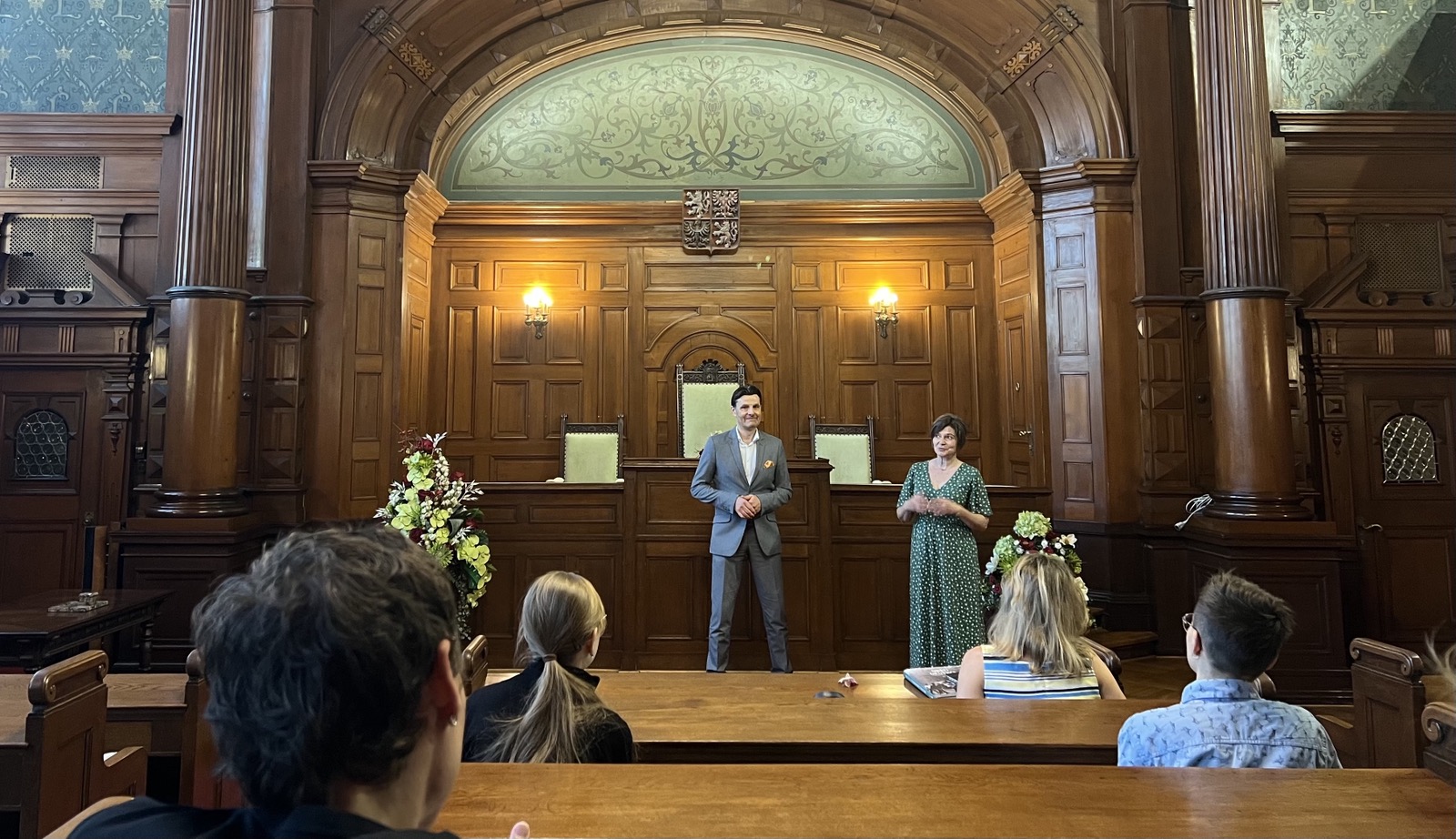
Adéla Gjuričová, Director Institute for Contemporary History Czechque Academie of Science and Ivan Langr, Deputy major for culture, education and and tourism.
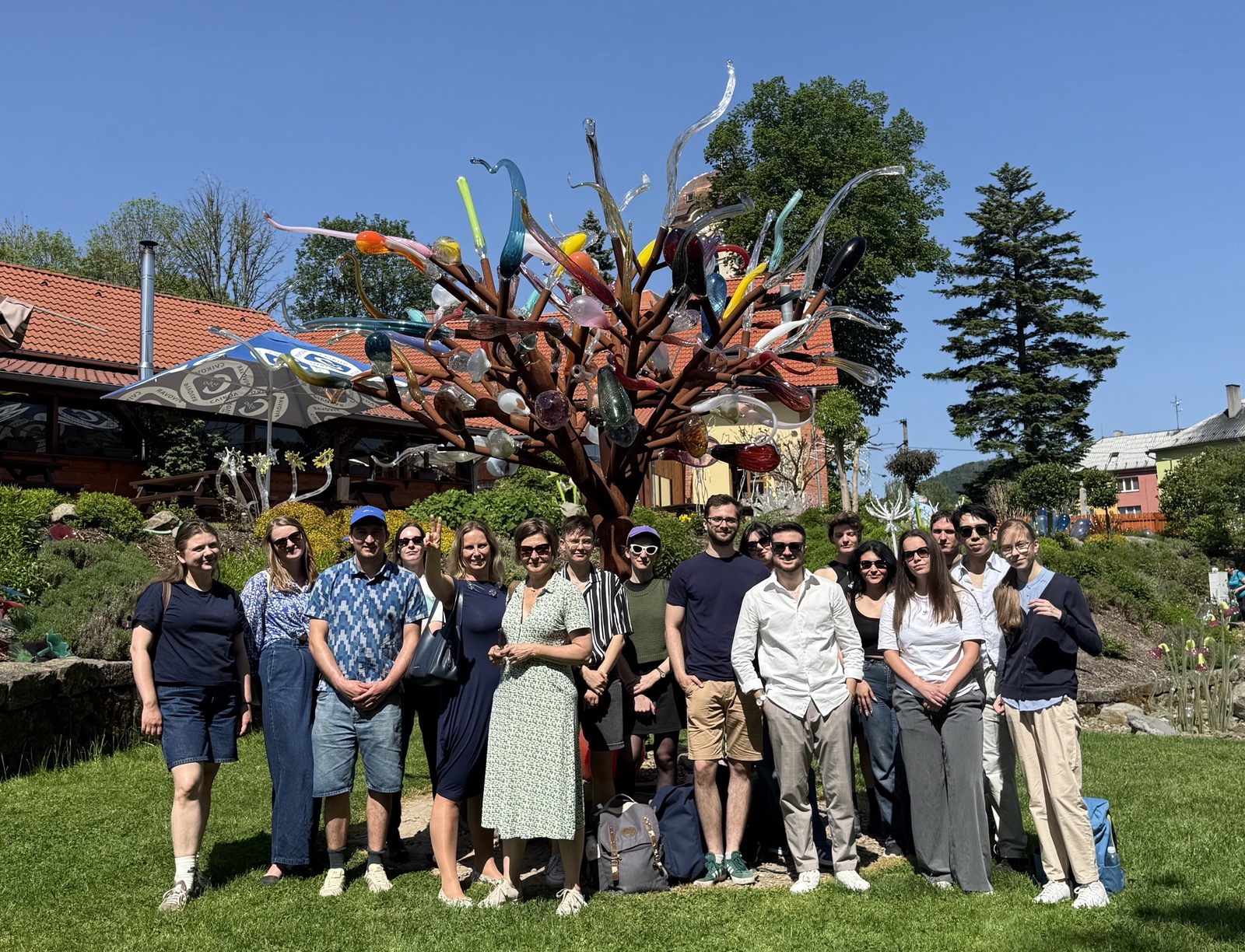
Tuesday was planned as a full-day excursion titled "Glass Impulse: When Art and Craft Meet the Periphery." We first traveled to Kunratice u Cvikova to visit the Pačinek glassworks, which features artisanal glass production, a gallery, a so-called Crystal Cathedral, and a glass garden. We then continued to Nový Bor, where the design studio Lasvit is based at the Glass House and works on projects for international hotels and opera houses worldwide. The excursion was analytically productive because of the contrast between these two poles: on one side, family-run craft businesses in structurally weak regions; on the other, globally operating design brands. The two sites are only a few kilometers apart, yet they follow entirely different logics. Nový Bor, where the design studio Lasvit is based at the Glass House and operates on projects for international hotels and opera houses worldwide. What made the excursion analytically productive was the contrast between these two poles: on one side, family-run craft businesses in structurally weak regions; on the other, globally operating design brands. The two sites are only a few kilometers apart, yet follow entirely different logics.
Wednesday's focus was the history of digital transformation, and the day's contributions connected directly to the research priorities of the project under whose auspices this blog appears. Johannes Kleinmann (Leibniz Centre for Contemporary History, Potsdam) spoke about digital inequalities from the 1970s to the present; a text by Nathan Ensmenger on gender roles in the computer industry was also discussed. Lenka Krátká (ÚSD Prague) complemented this with a presentation on the beginnings of the Czechoslovak IT community, drawing on oral history research and thereby offering a different methodological and thematic approach. The two contributions worked well together: one structural-analytical and comparative, the other centered on actors. In the afternoon, we visited the university's research laboratories for nanofibers. The University of Liberec is a leading institution in nanofiber and nylon development, used among other things in wound care. Afterwards, the historian and brewer Jan Havelka guided us through his inn, which has existed since the early twentieth century in a small village outside Liberec. Havelka has sought to restore the inn to its original state and to revive the region's historic craft traditions.
The final day was thematically framed around "City, War and Industry." After another round of student presentations, a workshop on the European Holocaust Research Infrastructure (EHRI) focused on forced labor and the use of EHRI's online tools. In the afternoon, we visited a former Wehrmacht factory where forced laborers from nearby concentration camps had produced war materials during the Second World War. Adjacent to the factory stood a memorial to the forced laborers — though there were no signs or directions of any kind leading to it.
The closing event was an open discussion in Liberec's Ratskeller, where we returned once more to the relationship between local history and technological developments. The summer school was more than a conventional workshop, above all because theoretical input was consistently linked to concrete places, actors, and objects. Liberec was thus not merely the location of the summer school but also its subject.
The summer school allowed us to see how inequalities manifested in local space before and after 1989 — in industry, in educational institutions, as a border region, and in gender relations. This complexity is reflected in our own projects as well: whether we are asking about the social effects of digital infrastructures, about exclusions in access to technology, or about the unequal distribution of technical knowledge — the question is always how social power relations inscribe themselves in technical systems and become entrenched there. Liberec reminded us that these processes are always concrete: bound to places, bodies, and historical ruptures. That was perhaps the most important insight we took back to Berlin.