

Workshop Recap: The Digital Transformation (Lucerne, Sept. 2026)
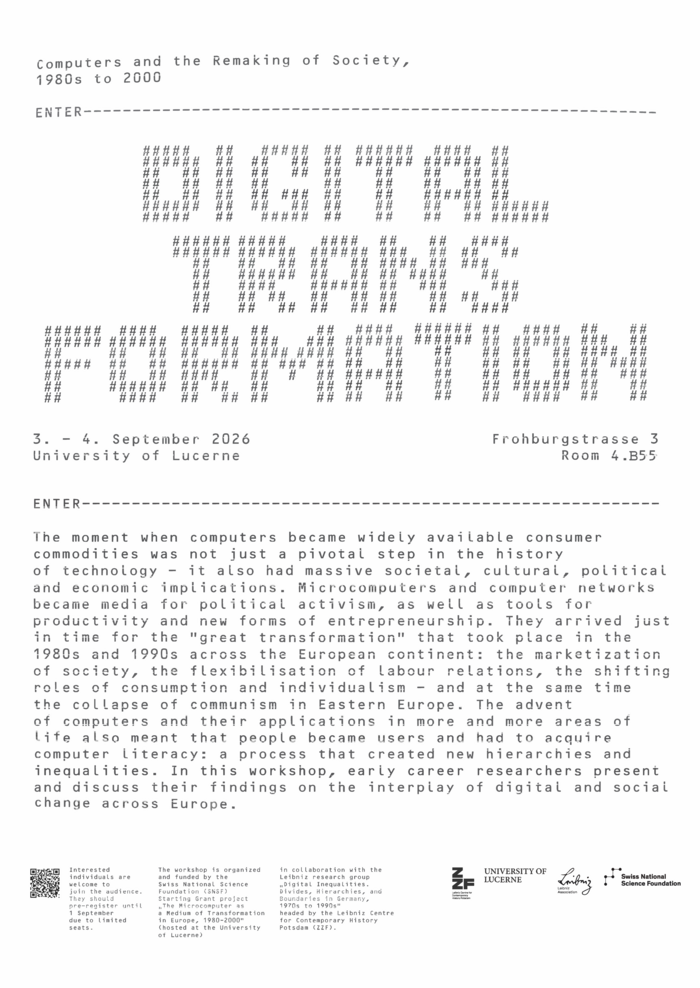
The Digital Transformation. Computers and the Remaking of Society, 1980s to 2000
How is it possible that we know almost everything about the technical development of computers, but far less about their impact on society, culture, politics, or economy? The workshop Digital Transformation. Computers and the Remaking of Society, 1980s to 2000 brought together scholars working on the social history of computing and digital transformation. Rather than treating computerization as a purely technological process, participants examined how digital technologies were shaped by, and in turn reshaped, social relations, political institutions, cultural practices, and everyday life during the great transformation across the European continent in the 1980s and 1990s. Featuring a wide range of case studies from Europe and beyond, the workshop highlighted the ways in which computers became embedded in broader projects of modernization while simultaneously producing new forms communication, community building and labour but also of inequality, exclusion, and contestation.
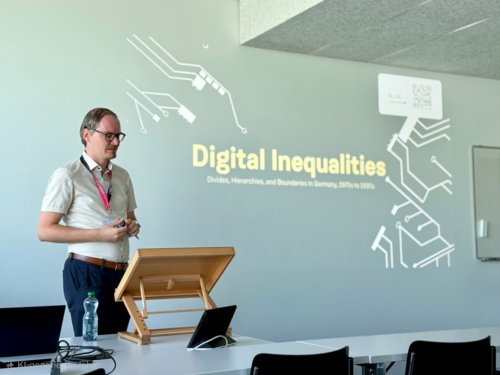
The opening contributions framed the workshop's central concerns. Both speakers emphasized the need to move beyond narratives of technological determinism and to look at the history of computing through the lens of social history. Framing history of computing as history of societies is indeed, as pointed out by GLEB J. ALBERT (Lucerne), the common ground among participators approaches: Understanding computerization as a social process closely intertwined with political transformations, economic restructuring, and changing cultural practices. Particular attention was also given to the concept of the digital society, with MICHAEL HOMBERG (Potsdam) highlighting that its promises of participation, democratization, and openness have often obscured the persistence of social hierarchies and the emergence of new digital divides.
In unison, several presenters consequently called for a stronger focus on users, everyday practices, and the social contexts in which computers were adopted and appropriated. A recurring theme throughout the workshop was the role of the state in regulating, promoting, and shaping digital technologies. Two papers on video game regulation in East and West Germany illustrated how computerization unfolded within distinct political systems while generating surprisingly similar concerns. The contribution of AURELIA BRANDENBURG (Bern) examined gaming magazines and their portrayal of state regulation between the 1980s and 2000. It demonstrated how debates surrounding censorship and indexing became central to the formation of German gaming culture. Gaming communities frequently developed narratives of victimization and state oppression, framing regulatory measures as attacks on personal freedom despite their relatively limited practical impact. These discourses often reinforced masculine identities and contributed to the construction of a shared gamer culture, serving as glue within the community.
NILS BÜHLER (Cologne) placed West German regulation in a longer historical perspective and compared it with state approaches in the GDR. While video games in the Federal Republic emerged in an initially unregulated market and later became subject to youth protection policies, East German authorities integrated gaming into existing systems of surveillance, censorship, and economic planning. Yet, both German states regarded the new medium with scepticism and sought to channel it according to broader political and social objectives. Taken together, the papers challenged simplistic assumptions about freedom and control, revealing instead a complex history of state intervention and cultural negotiation.
Two more contributions focused on the relationship between states and the ongoing technological advancement, presenting two state-led modernization projects – interestingly both describable as failures – and the often-uneven realities of computerization. IVO FURMAN (Istanbul) examined the educational reform in Turkey and explored how computers became symbols of economic liberalization and technological progress during the 1980s. Ambitious government programs promised to equip schools, expand computer literacy, and prepare citizens for a rapidly changing economy. Yet financial constraints, procurement controversies, and infrastructural shortcomings limited the implementation of these plans. The resulting history was not one of straightforward modernization but rather of recurring tensions between political visions and practical realities
Similar dynamics emerged in a presentation on the West German migration database and the origins of the Schengen Information System. Conceived as a tool for administrative efficiency and political modernization, the database struggled with technical deficiencies, organizational fragmentation, and persistent inaccuracies. Far from solving existing problems, as shown by LENNART V. SCHMIDT (Potsdam), computerization often reproduced or even intensified bureaucratic shortcomings. Particularly striking was the paper’s argument that databases themselves became political actors by defining administrative categories and shaping governmental understandings of migration. The contribution therefore highlighted how seemingly technical systems could profoundly affect social realities.
Questions of inequality featured prominently throughout the workshop. Several papers demonstrated that digital technologies frequently reproduced existing social divisions even while promising greater inclusion. This was especially evident in discussions of gender and computerization. LAURA KURZ’ (Darmstadt) presentation examined feminist research and policy initiatives in Germany during the 1990s, tracing debates surrounding technology education, internet access, and gender-sensitive approaches to computing. While researchers increasingly challenged assumptions about women’s supposed technological deficiencies, many policy interventions continued to focus on helping girls and women adapt to existing technological cultures rather than transforming the masculine norms that structured those environments.
A complementary perspective emerged from NINA NEUSCHELERs (Potsdam) work on women's clerical work and office computerization. Contrary to widespread fears that digital technologies would eliminate jobs, computerization often reconfigured rather than replaced secretarial labour. New technologies transformed workplace hierarchies, increased responsibilities, and created opportunities for professional advancement. At the same time, debates surrounding health risks, technological competence, and workplace modernization revealed persistent, gendered assumptions. Both papers therefore demonstrated that digital transformation cannot be understood without considering the ways in which technology and gender were mutually constitutive.
Once more, educational settings prove to provide a lens which to examine digital inequalities. A contribution from TIM SCHINSCHICK (Braunschweig) on computer education in West German schools investigated how access to computers was distributed across different school types and social groups. Although policymakers often presented computer literacy as a means of democratization and equal opportunity, access remained highly uneven. High Schools (Gymnasien) were significantly better equipped than other schools, and classroom interactions frequently reinforced gendered patterns of participation. Yet the paper also revealed more inclusive dimensions of computerization, particularly through initiatives that employed digital technologies to support students with disabilities. Such examples complicated narratives of technological exclusion by demonstrating how computers could also serve as instruments of empowerment.
Another major theme concerned the role of users and communities in shaping digital cultures. Several presenters challenged top-down narratives of technological change by highlighting practices of appropriation, experimentation, and collective knowledge production. A paper on Spain's 8-bit computer culture by IGNASI MÉDA CALVET (Barcelona) illustrated how users actively participated in constructing the meanings and uses of computer technology. Computer magazines, hobbyist communities, and shared programming practices fostered collaborative learning environments in which technological knowledge circulated beyond formal institutions. Rather than passive consumers, users emerged as key actors in the development of computing cultures.
Similar questions surfaced in a contribution on German reunification and computing communities. Drawing on magazines and online discussion forums, the paper explored expectations, fears, and misunderstandings surrounding the encounter between East and West German computer users. DAVID BETZING (Lucerne) showed that while some computer magazines had meditating roles enhancing Glasnost, Western actors often regarded their eastern counterparts as technologically backward, to be then frequently surprised by the expertise and creativity that had emerged under conditions of scarcity. The paper highlighted the importance of informal knowledge and local practices in shaping digital transformation during periods of political upheaval.
The significance of computer-mediated communication formed the focus of two papers investigating digital networks before the internet era. MILKA LEHNER (Lucerne) analysed bulletin board systems during the Bosnian War, demonstrating how these networks enabled the circulation of information outside official propaganda channels. Despite severe infrastructural limitations, transnational networks created spaces for communication, documentation, and resistance. At the same time, the contribution cautioned against romanticizing these technologies, showing that online interactions also reproduced social and political tensions. ANTONINO SCIOTTO (Vercelli) examined telematic networks within the Italian radical left. By tracing the development of activist infrastructures from BBS systems to internet-based networks, it revealed how social movements experimented with new forms of political communication and transnational cooperation. Both contributions underscored the value of studying digital networks not merely as technological infrastructures but as social spaces shaped by political practices, cultural meanings, and collective identities.
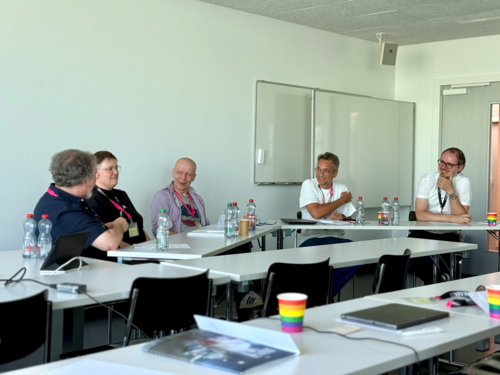
The concluding roundtable and final discussion shifted attention from historical actors to the historians studying them. MARIA B. GARDA (Turku), IVO FURMAN (Istanbul) and PATRYK WASIAK (Warsaw) reflected on the methodological challenges posed by digital history, including the preservation of born-digital sources, the interpretation of online archives, and the ethical implications of researching communities whose members are still alive. Discussions emphasized the importance of combining digital methods with established historical research practises, such as oral history, traditional archival research, and critical source analysis. Concerns about archival preservation, selective survival, and the underrepresentation of marginalized voices highlighted the extent to which future histories of computing will depend on present-day decisions regarding documentation and access.
The role of artificial intelligence generated a particularly lively debate. While participants acknowledged the potential of AI for tasks such as source processing and OCR enhancement, they also warned against uncritical adoption and questioned the added value when using LLMs only, instead of implementing GPU based systems. Questions of transparency, reliability, authorship, and digital heritage emerged as central concerns, suggesting that current discussions surrounding AI may eventually occupy a place in historiography comparable to earlier debates about computerization itself.
Providing, above all, younger researchers with the opportunity to present their projects, the workshop convincingly demonstrated the value of approaching the history of computing as social history. The Roundtable – and in particular the in-depth discussion of methodology – was a valuable addition, since the topic of methodology had been somewhat neglected in the otherwise very interesting and lively discussed presentations. Across diverse national contexts, participants showed that digital transformation was neither technologically predetermined nor universally beneficial. Instead, it unfolded through negotiations among states, institutions, communities, and individual users. Findings that are lost when adopting a technology-deterministic approach. The workshop’s comparative and interdisciplinary perspective highlighted both the promises and limitations of computerization while drawing attention to the inequalities, conflicts, and unintended consequences that accompanied digital change. By situating computers within broader processes of social transformation, the contributions offered important perspectives for understanding the historical roots of contemporary digital societies. As we are in the middle of new technology debates, understanding how society and technology influence each other can be particularly valuable these days.
Written by Loredana Bevilacqua, first published as: Tagungsbericht: Digital Transformation. Computers and the Remaking of Society, 1980s to 2000, in: H-Soz-Kult, 16.11.2026, https://www.hsozkult.de/conferencereport/id/fdkn-165575.
Conference overview
Gleb J. Albert (Lucerne) / Michael Homberg (Potsdam): Welcome/Introduction
Panel I
Aurelia Brandenburg (Bern): Mom Wanted to Take ‘Their’ Games Away? German Gaming Magazines and the Myth of the State as an Oppressor of Gamer Culture 1980–2000
Nils Bühler (Cologne): Divided yet United? An Entangled History of East and West German Video Game Policy
Panel II
Ivo Furman (Istanbul): Framing Computer Literacy. Computing Magazines and Educational Reform in Türkiye, 1984–1991
Lennart V. Schmidt (Potsdam): Coding the Border. West Germany’s Migration Databases and the Making of the Schengen Information System, 1967–1995
Panel III
Laura Kurz (Darmstadt): Co-constructing Gender-sensitive Technology. Scientific Approaches and Policies in Germany in the 1990s
Nina Neuscheler (Potsdam): From Secretary to Assistant. How Computers Transformed Women’s Clerical Work
Panel IV
David Betzing (Lucerne): Digital Unification. Reactions from West German Gaming Actors to Reunification
Ignasi Medà Calvet (Barcelona): Domesticating the Microcomputer. User Appropriation and the Construction of the Spanish 8-bit Videogame Market (1980–1990s)
Panel V
Milka Lehner (Lucerne): The Peaceful Computer versus “Evil Media”? BBSs During the Bosnian War 1992–1995
Antonino Sciotto (Vercelli): Local Connections, Global Relations. Italian Radical Left and Telematic Links
Panel VI
Tim Schinschick (Braunschweig): ‘Chancengleichheit’ in Computer Classes? The Introduction of Computers in West German Schools as a History of Digital In-/Equalities
Roundtable: Doing Computing History. Approaches and Blind Spots
Participants: Maria B. Garda (Turku) / Ivo Furman (Istanbul) / Patryk Wasiak (Warsaw) / moderated by Gleb J. Albert (Lucerne) / Michael Homberg (Potsdam)